Tigers and Snowmen

Cat of the Month ~ January 2013

Longleat Tiger

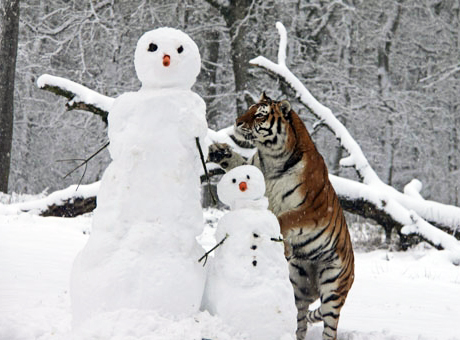
Tiger meets snowmen
All Photographs: https://www.longleat.co.uk

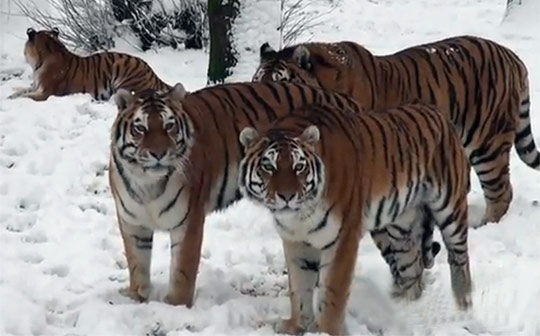
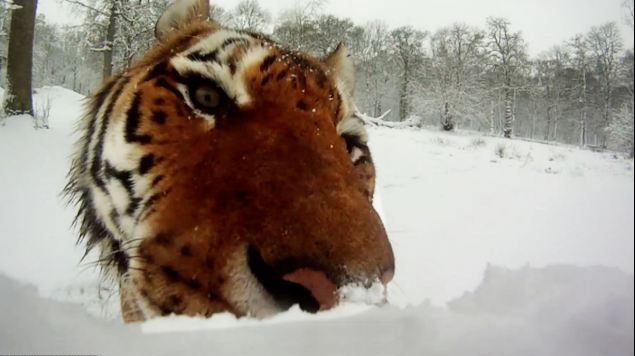
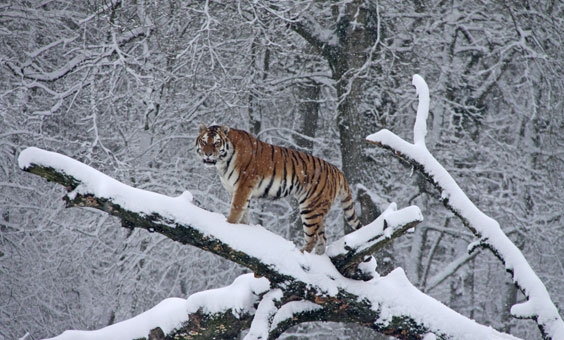
Longleat’s four Amur (Siberian) Tigers were fascinated by the deep snow outside and were always going to make the most of ‘snow day’ when it came around.

…So where are these snowmen you promised?…

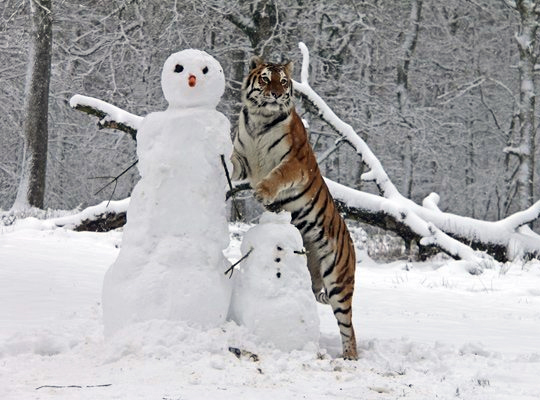
… but when their keepers decided to build some snowmen, things got more exciting and they just had to go in to investigate….

…Look at me guys,….. hey this is fun

So what were these strange white creatures with orange noses…..

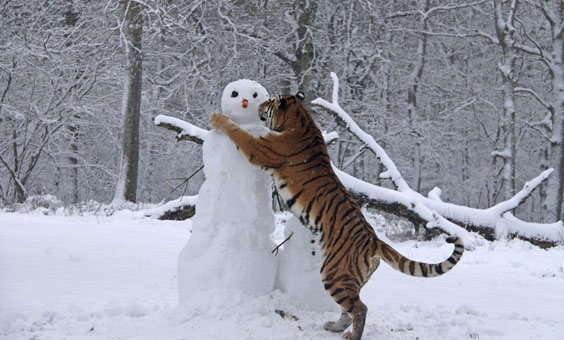
…How about a little hug then?…
Photograph: https://www.longleat.co.uk

So inquisitive were the four handsome beasts that they caused the fragile snowmen to collapse…..

…Whats that Camera doing in there?…

…and so, it was off to explore the rest of their snow bound enclosure before retiring to a snug warm pen for the evening.

…nice old tree trunk this…
…Hey I’m cat of the month you know?…
… oi, what are you up too?.. this is a moggies only website….oh you’re sooo cute so its o.k. I guess

Heres the video of the whole episode

…or head over to the
Longleat
website for these and many other wonderful animals.

And what’s an Amur Tiger? you might ask. Well here’s a pretty concise article on the National Geographic website.

Cat Show Capers

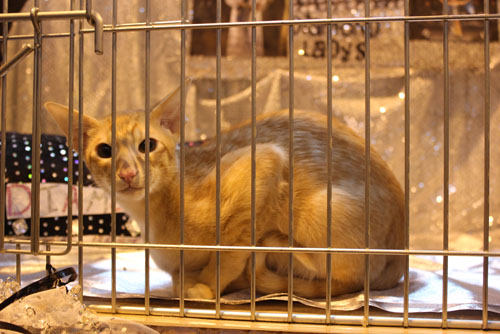
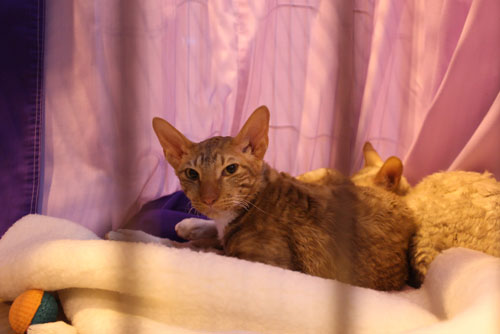
Reader, just a few pictures from the annual Supreme Cat show here in Birmingham, England.
The one-day Supreme Cat Show (aka The Governing Council of the Cat Fancy’s ‘Supreme Championship Cat Show’ … phew) is one of the largest cat fancy competitions in Europe with over a thousand cats being exhibited. Best in breed awards up for grabs include: Persian, Semi-Longhair, British, Foreign, Burmese, Oriental and Siamese.

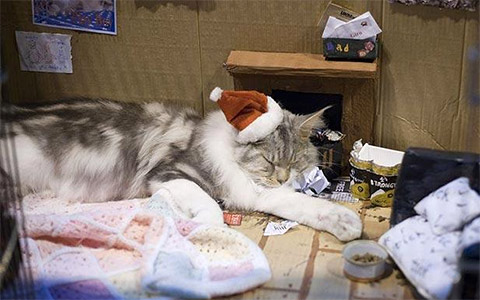
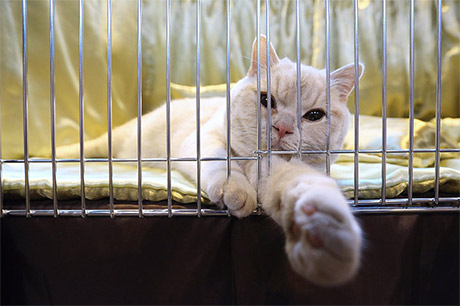
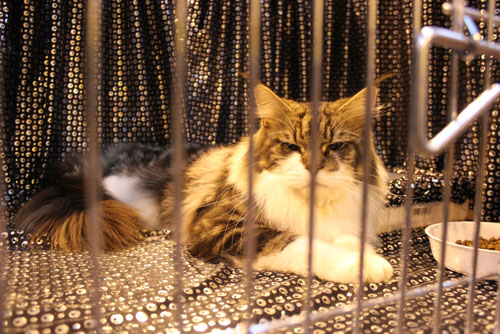
All these posh moggies have to endure hours in cages for their art and beauty. But they do have all mod cons in there, including plumped cushions, fireplaces and (in one case) tins of cider…. Norman tells me that’s all very well but how the heck do they cope with the boredom of being stuck in a cage for most of the day!


It’s Showtime for Mr Twizzle and his pals
Photograph: Ed

‘Lionmaine Bearface Brian’, flakes out in his own front room, complete with fireplace and cans of cider…mmm
Photograph: Geoff Pugh

Do you mind, I’m trying to sleep
Photograph: Ed

‘Bleugems Believe-in-me’ …. What Cattitude!
Photograph: Oli Scarff/Getty Images

Another batch of longhairs ready for inspection
Photograph: Ed

“I used to be a ratter in a former life you know”

Photograph: Ed

….excuse me I’m nodding off again
Photograph: Ed

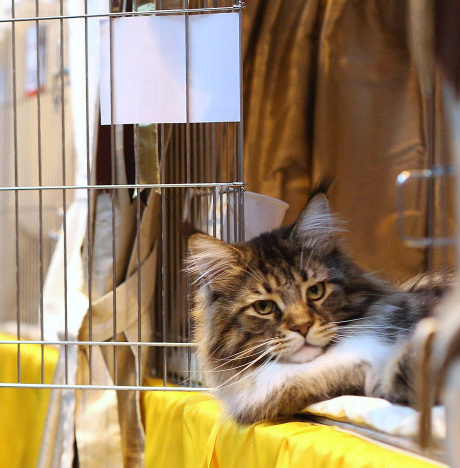
The Norwegian Forest Cat, Mr Bojangles has a stretch (and what a beauty)
Photograph: Oli Scarff/Getty Images

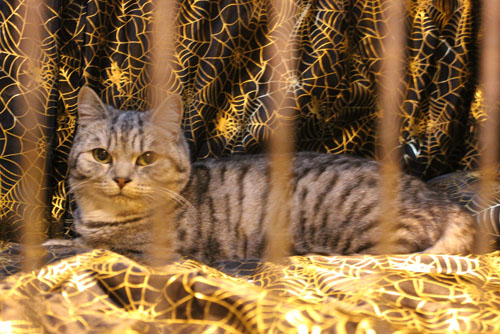
Come into my parlour said the spider to the fly. (funny looking spider Ed, :no: Norm)
Photograph: Ed

You lookin’ at me!
Photograph: Ed

One more inch and I’ll have your nose
Photograph: Ed

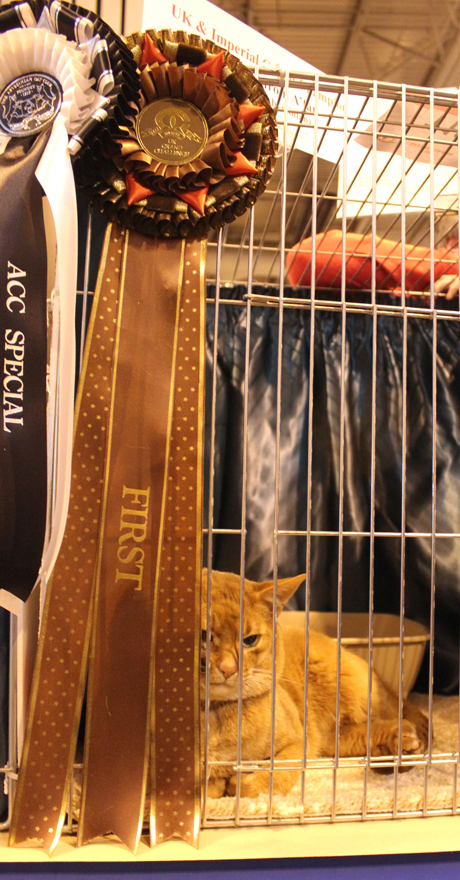
Cheer up Puss, You Won!
Photograph: Ed

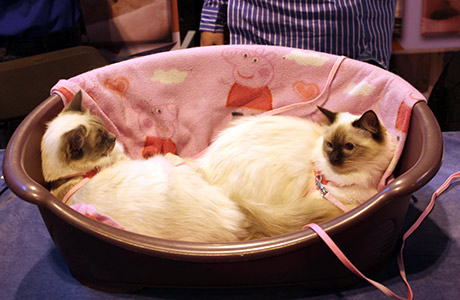
A pair of Chocolate Point Birmans cuddle up
Photograph: Ed

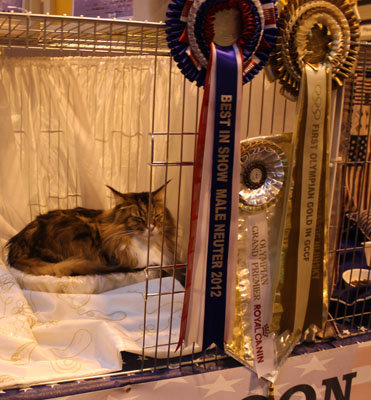
A Forest Cat dreams of his forest
Photograph: Ed

A Maine Coon goes dotty with boredom
Photograph: Ed

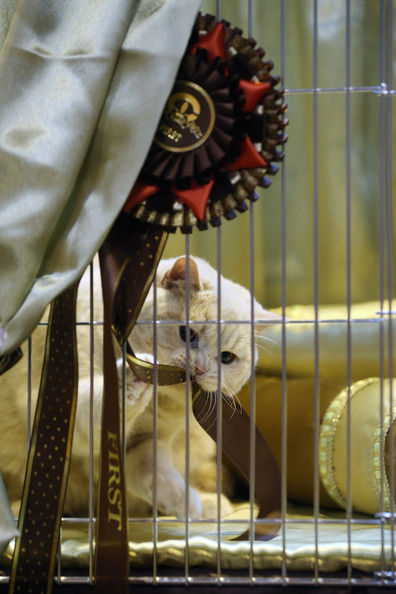
This is MY rosette
Photograph: Oli Scarff/Getty Images

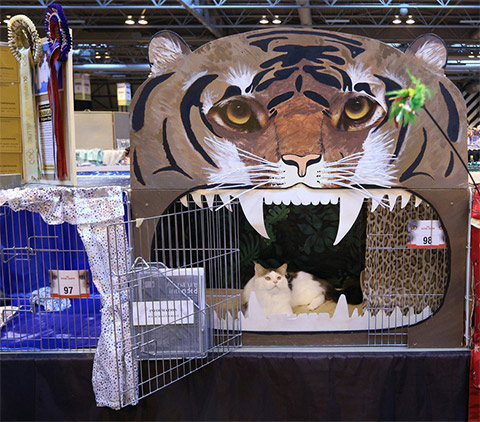
Swallowed by a big cat
Photograph: Oli Scarff/Getty Images

To see all the winning cat breeds please follow this link:
https://www.babble.com/pets/winners-of-2012-supreme-championship-cat-show/

Hercules the Liger

It’s official! Hercules the Liger is the Largest cat in the world, and what a beautiful creature he is, standing an amazing six foot to the tips of his ears!

Cat of the Month ~ November 2012

hurcules the liger

Hercules the Liger ~ The largest cat in the world
Photograph: Splash News

Hercules is indeed a massive and sturdy beast, being the largest living liger. If fact he is also recognized by the Guinness Book of World Records as the largest living cat on Earth, at 6 foot tall and weighing in at over 410 kg (904 pounds or 64 stones). He is a completely healthy and lively cat and is expected to live a long life. (how would you like to get in a play fight with him, eh Ed? (Norm).

Hercules and his brother Aries (born in 2010) are both being raised at Myrtle Beach Safari Park wildlife reserve in South Carolina. It is said that the breeding of these large cats was (in this case) a complete accident. Many Believe that the interbreeding of different species of cat (or any animal for that matter)is not to be encouraged as it can cause medical disorders in the offspring.

Long ago (in 19th century India) ligers were first discovered in the wild (born out of encounters between Lions and Tigers when the territories and breeding grounds of these big cats overlapped). Today no such wild ligers are known to exist.

So then, Ligers are a cross breed between a male lion (Panthera leo) and a tigress (Panthera tigris). Just like their mothers (Tigers) Ligers love to swim, and like their fathers (Lions) they are very sociable and playful. Notably, ligers typically grow larger than either parent species (unlike Tiglons which tend to be about the size of a tigeress).

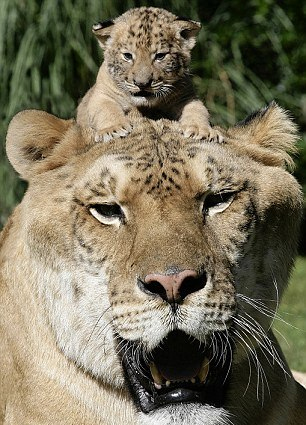
Tiny Aries, standing on the head of his brother Hercules – Today Aries will be almost as big as his brother
Photograph: Splash News

Donskoy

The Donskoy (or Don Sphinx) is a highly intelligent, beautiful and friendly cat breed type which originated in southern Russia in the city of Rostov-on-Don (near the Sea of Azov) in 1987.

Cat of the Month ~ October 2012
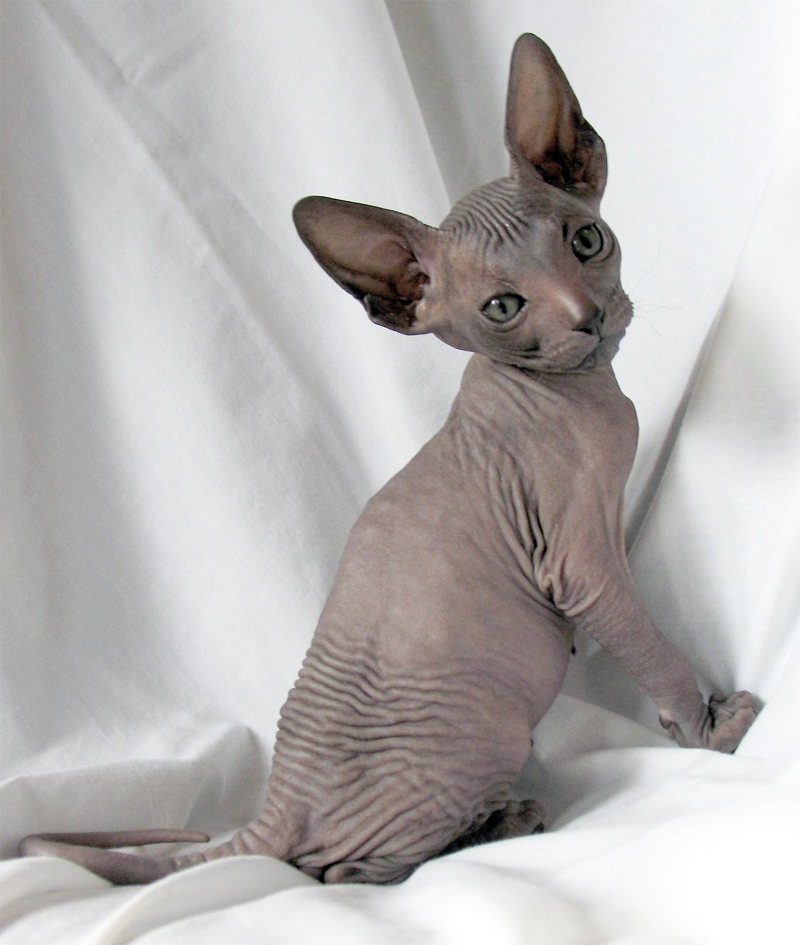
A young Donskoy ~ not always bald at birth
Photograph: petsphoto.com

The story goes that Elena Kovaleva, a professor of the nearby State Pedagogical Institute, saw some young boys playing with a bag. When she heard a kitten inside the bag squealing in fear and pain, Elena took the bag from the boys and brought the young kitten home. She named the kitten Varvara, but over the following months the kitten grew up like no other cat she had seen. It lost its hair and was treated (in vain) for this seemingly fatal condition. The cat thrived however and a few years later gave birth to both haired and completely hairless kittens. Strangely those kittens with hair also began to lose it, just as their mother had done years before.

Many thought that these hairless kittens were unhealthy and should be gotton rid of. However, a local enthusiast and professional cat breeder by the name of Irina Nemikina, rescued one of these kittens and in several years had managed to breed a completely new type of Russian cat (a hairless one) which she named the ‘Don Sphynx’. ‘Don’ after the river which Varvara was found beside and ‘Sphynx’ because it was hairless just like the sphynx breed. It was The International Cat Association which gave this unique cat type the name of ‘Donskoy’.
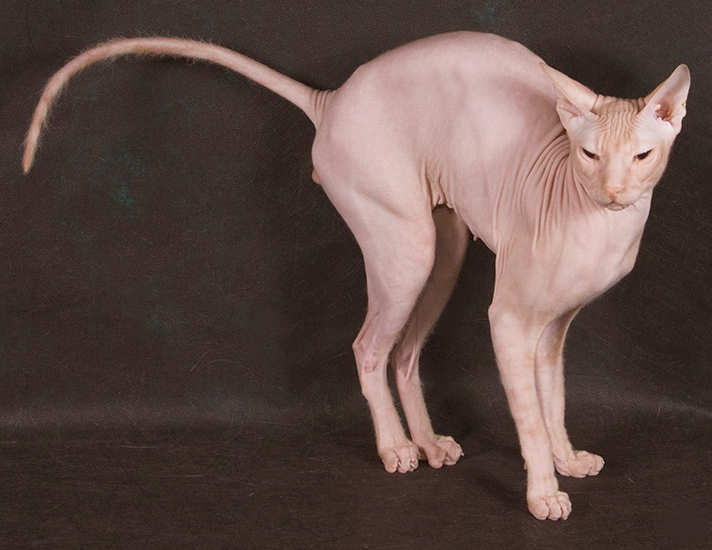
An adult Donskoy, a loyal and good-natured companion
Photograph: unknown

The Donskoy is a very elegant, highly inquisitive, and social cat. They are also very active and almost always extremely friendly. For owners the Donskoy is very loyal, good-natured, gentle, and easy to groom and handle. Their coats are warm and soft to the touch making then wonderful to hold and cuddle. They have a well balanced personality, show a lively interest in their surroundings, and enjoy making up & playing games. Donskoy are extremely affectionate and they have an irrepressible curiosity (even more evident than in other cats). Their social skills are also transferred to other animals to which they will offer companionship. It is recommended that these highly sociable cats are found companion pets and should not be kept in isolation with just humans. Owning a Donskoy you will find they will love to be a part of all your activities and they will be easy to train to follow your voice commands.

A young Donskoy will have a coat of one of four types in a range of colours. All but one of these coats usually results in hairlessness in later life. This is due to the Donskoy carrying a dominant hair loss gene that causes their birth coat to fall out (if they have one) in later life.

Their coats are:
Rubber Bald — The rubber bald is born bald and remains that way throughout its life.

Flocked – The Flock coat appears to be hairless and has the texture of soft chamois leather. The Flock coat can sometimes disappear and the cat can sometimes become bald.

Velour – The velour coated kittens are born with a bald spot or Monk’s cap on the top of the head. Their wool-like coat becomes wiry and disappears gradually within the first year or so with some residual hair remaining on the face, legs and tail. The Velour can also completely lose their coat and become bald over time.

Brush – Brush type coats lose only a portion of their coat over time. Their coat can be bristly, soft, wavy, and often wiry on their whole body with bald areas on the head, upper part of neck or on the back.

The Donskoy is further unique in that it can grow a winter coat (fine wool on the chest and hairs on the end of the tail) which it will lose when the weather warms. Their skin is similar to human: it sweats when it is hot and it can also become tanned by the summer sun.
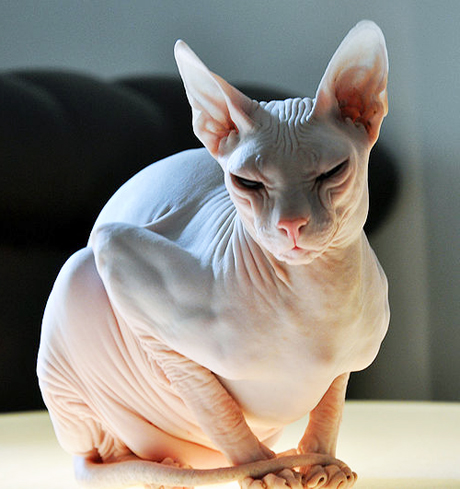
Donskoy’s have a marvellous appearance wouldn’t you agree?
Photograph: unknown

Donskoy are elegant, sturdy and muscular with strong boning. They are a medium-sized cat with soft hairless wrinkled skin that feels hot and velvety to the touch. Their skin is excessively elastic, with pronounced wrinkles on the cheeks, jowls and under the chin with vertical wrinkles separating their ears and running down the forehead, spreading into a series of lines above the eyes. Wrinkles are also found at the base of the neck, in the breast area, at the base of the tail, on the front and undersides of the legs, down the sides of the body to the underbelly and groin.
Males as a rule are generally larger than females. The Donskoy is medium to medium-long in length, dense, muscular, strong-boned, with wide breast and croup. They have a deep groin-line with a well-rounded abdomen called a fatty belly where fat accumulates in the winter. Their body is almost pear shaped.

The male has stud jowls, a thicker neck, wider shoulders, and a broader head than the female. The male is more muscular and gets significantly larger than the female. The front legs are shorter than their back legs yet are in proportion with their body. They have oval feet with long slender toes. Toes are very long, slim and distinguished with thumbs that bend inward rather than downward on the front paws giving the appearance of slender hands (like monkey fingers). Webs separate the long toes. Their tail is medium long, straight and tapers from body to rounded tip.

The Donskoy was first officially recognized by World Cat Federation (WCF) in 1997, and by The International Cat Association (TICA) in 2005. The standard of points describes the cat as being medium sized and muscular, with large ears, almond shaped eyes and distinctive long, webbed toes. They require frequent grooming, in spite of their lack of coat. Also over-bathing can cause the skin to become very oily.

The Peterbald breed was originally created by crossing Donskoy with Siamese and Oriental cats to create a hairless cat of Oriental type. Matings between Donskoy and Peterbald are no longer permitted however.

[sources: The TICA website and Wikipedia.org]
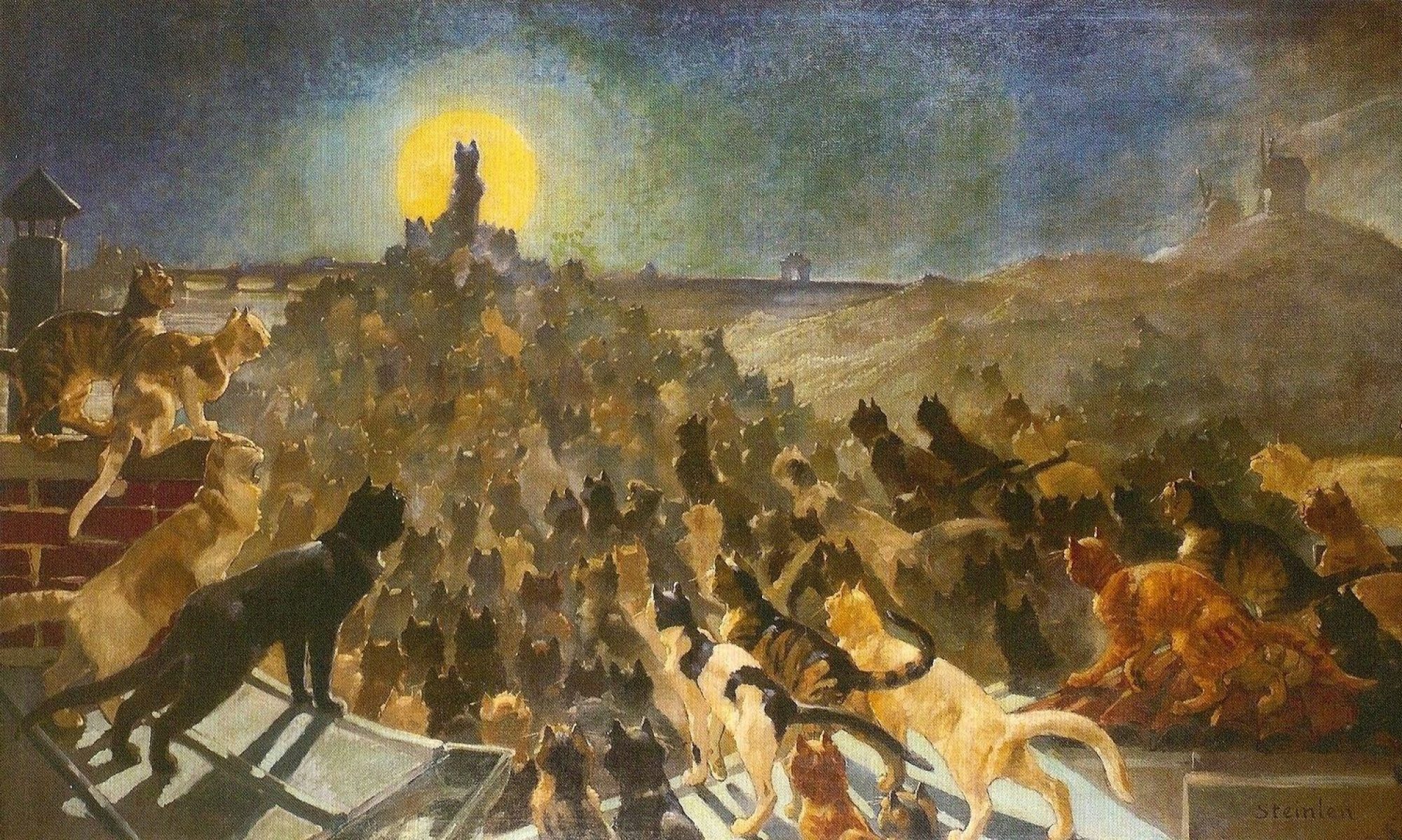
The Sofa Cats

Cat(s) of the Month ~ September 2012

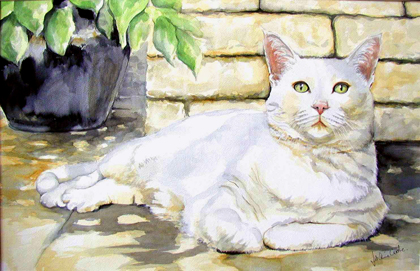
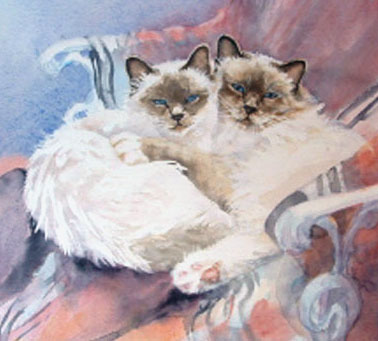
The Society of Feline Artists, or S.O.F.A for short, was founded in September 1994. They have the aim of promoting the work of the best cat artists, whether established or unknown….and what an amazing collection of feline portraits they have in store on their website!

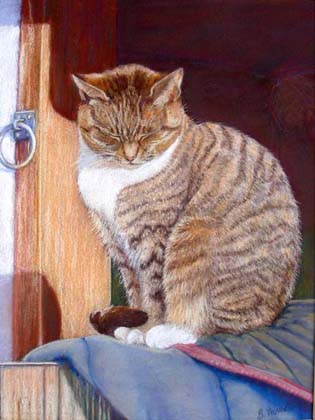
Stable Cat
Painting/Photograph: Barbara Thaxter

The society has had an annual exhibition of cat paintings at the Llewellyn Alexander Gallery in London for several years, featuring over 100 artists, some of whom exhibit internationally and showing more than 300 paintings in a range of media, making it the largest exhibition of cat art in the United Kingdom.

Subjects range from the humble moggy and the friendly domestic tabby to the more exotic breeds like Siamese, Burmese and Bengals and of course the Big cats. From the nobility and drama of the wild cat to the playful kitten – all are painted with the mastery of artists who know and understand their subject.

Norman and I have looked through the gallery on the S.O.F.A website and selected some of the pictures which have caught our eyes. We hope you like ’em too.

Barbara Thaxter

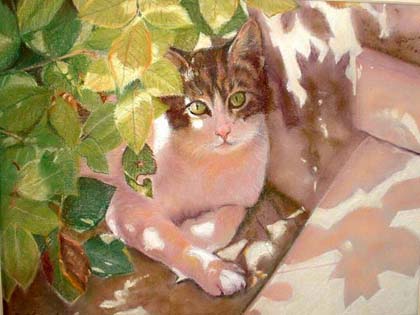
A Shady Place
Painting/Photograph: Barbara Thaxter

Jackie Coote

Frankie ‘The Professor’
Painting/Photograph: Jackie Coote

Sunbathing
Painting/Photograph: Jackie Coote

Kay Young

Jaguar
Painting/Photograph: Kay Young

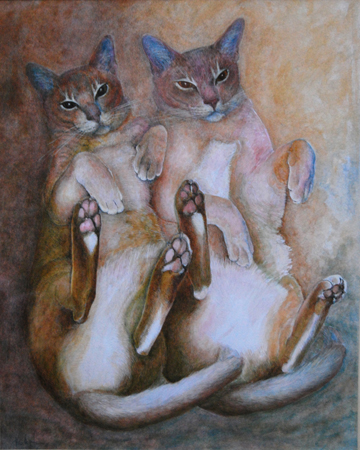
Jasmine and Bertie
Painting/Photograph: Kay Young

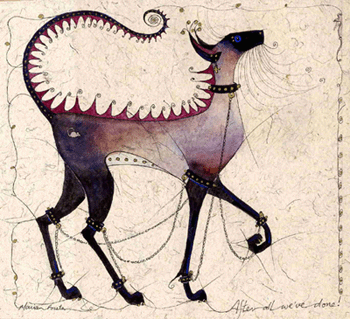
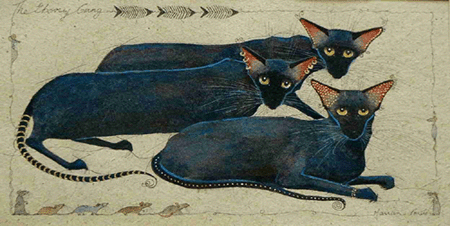
Marion Forster

After all we’ve done
Painting/Photograph: Marion Forster

Ebony Gang
Painting/Photograph: Marion Forster

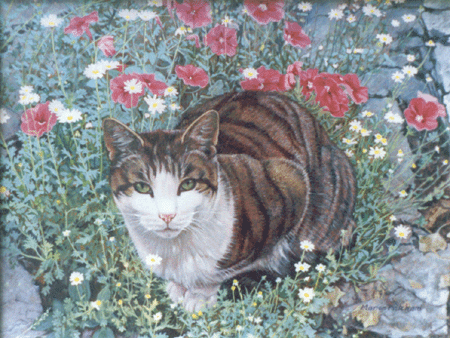
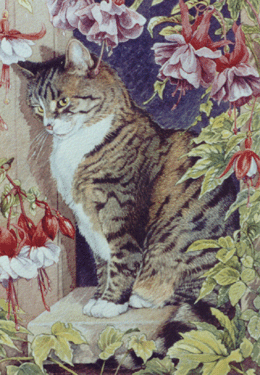
Marion Pritchard

Everything in the garden is lovely
Painting/Photograph: Marion Pritchard

Tabby with Fushias
Painting/Photograph: Marion Pritchard

Sue Sareen

Black and White Cats
Painting/Photograph:Sue Sareen

Two Kitties
Painting/Photograph:Sue Sareen

Alex Johnson

Sitting Pretty
Painting/Photograph:Alex Johnson

Watching
Painting/Photograph:Alex Johnson

Not forgetting a link to the S.O.F.A Website where there are a whole lot more artists and their paintings.

One Homeless Cat

We’ve found out recently of just how many cats around the world currently need loving homes. Here’s one such cat ‘Leo’ we chose at random. We don’t know Leo personally but just saw his cute face staring back at us from the Swansea Cat Protection website.

Cat of the Month ~ August 2012

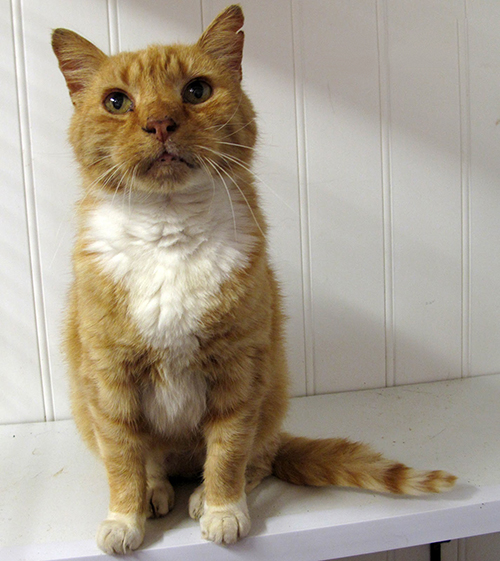
Leo, One homeless cat to go
www.swanseacats.blogspot.co.uk

.. for cats like Leo, who sit around waiting for a Friend to come along, the motto of Cats Protection comes to mind

‘Our vision is a world where every cat is treated
with kindness and an understanding of its needs’

Cats Protection is one of many different cat charities in the United Kingdom. It was founded in the in 1927 and today helps more than 230,000 cats and kittens every year through a network of over 250 volunteer-run branches. They also have 29 adoption centres and a homing centre. They certainly gave me shelter for months and helped me find a new home!

To think about all these English (and World) cats in need can be a bit disheartening, so it is better to think globally but act locally (this is indeed my motto when I go off and put my scent marks in other people’s gardens).

If you can personally offer a home to a cat then there will be a cat rescue centre near you you can find online. Of course if you cant adopt then you could support the great work these Cat (and Dog) hostelries do with a one off inexpensive sponsorship or donation. You can get to visit all these lovely cats this way too. Just ask your local adoption centre for details.

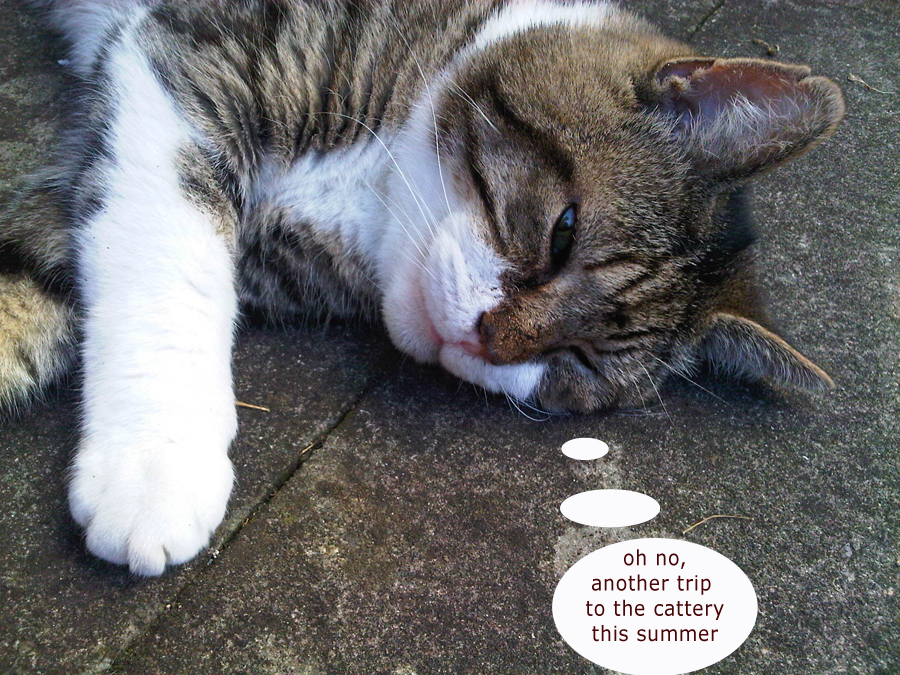
As for me, well wouldn’t you know its holiday time (for some) again, so I’m going to be temporarily joining the throng of disowned cats when I’m packed off to the local cattery.
So I’d best now wish all you cats out there a safe, healthy and happy summer 2012

All my love,

Norm. x X x

Christian the Lion

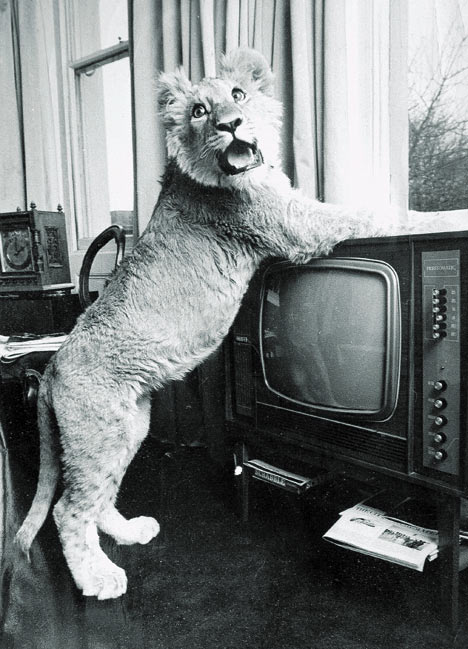
Christian was a 35 pound lion cub (and a “gorgeous” cat) when John Rendall and Ace Bourke discovered him in the Harrod’s department store window.

The year was 1969, and Christian had been put up for sale by the store for 250 guineas (or about 280 pounds). The store had acquired the cub from Ilfracombe Zoo as a sales gimmick, but it had all gone wrong when the inquisitive feline escaped from his cage one night to take a sniff at some goat skins on sale in the carpet department. Needless to say he proceeded to wreak havoc…

Cat of the Month ~ July 2012

Christian the treasured friend of Ace and John.
Photograph: alioncalledchristian.com.au

On seeing the lion the two friends were dismayed and convinced they could give the lion a better home. The two purchased the cub and took him to their flat above the trendy ‘Sophistocat’ furniture shop on Kings Road, in the heart of 60’s “Swinging London”.

Christian was a lively, friendly and intelligent cub who slowly built a bond of genuine friendship and trust with John and Ace. He also turned into a local celebrity over the next five months, and produced smiles in all who met him. However the cub was growing fast and in just a few months he became a giant of 185 pounds.

At this point Rendall and Bourke realized they couldn’t keep the Lion much longer. The story has a first amazing twist when a fortuitous chance encounter took place…

One day Bill Travers and Virginia McKenna the stars of the 1966 film Born Free wandered into ‘Sophistocat’ looking for a writing desk. The actors, hearing of the friends plight at this ever growing Lion suggested that conservationist George Adamson be contacted (George’s wife, Joy, wrote the book ‘Born Free’ about real-life experiences in raising a lion cub). So taking the good advice, Christian was soon shipped out to Africa where he was carefully rehabilitated and released into the wild.

The final chapter in the story occurred in 1974, when Rendall and Bourke decided to visit Christian for one last time. They knew he was now a wild animal, so could he be found in the wilds of Kenya….and if they found him would he remember the two surrogate friends? … Adamson told them “it was doubtful that Christian could ever be found…. No one had seen him in nine months”.

The two flew to Kenya anyway, and the amazing coincidence is that on the day they landed, Christian (not seen for those nine months) appeared outside Adamsons camp (perhaps knowing his old pals were coming to see him). He was seen waiting outside the camp until Rendall and Bourke arrived. The reunion of this Lion with his human friends is now a well known story which has been made into a film recounting his journey across the globe, rehabilitation in Africa and eventual return to the wild. The video shown below shows the reunion of Ace and John with Christian.

Christian the Lion, a reunion
Video: alioncalledchristian.com.au

Christian is starting to get Big!
Photograph: alioncalledchristian.com.au

For lots more pictures please visit A Lion Called Christians Gallery Pages