
African Leopard

Cat of the Month ~ May 2011
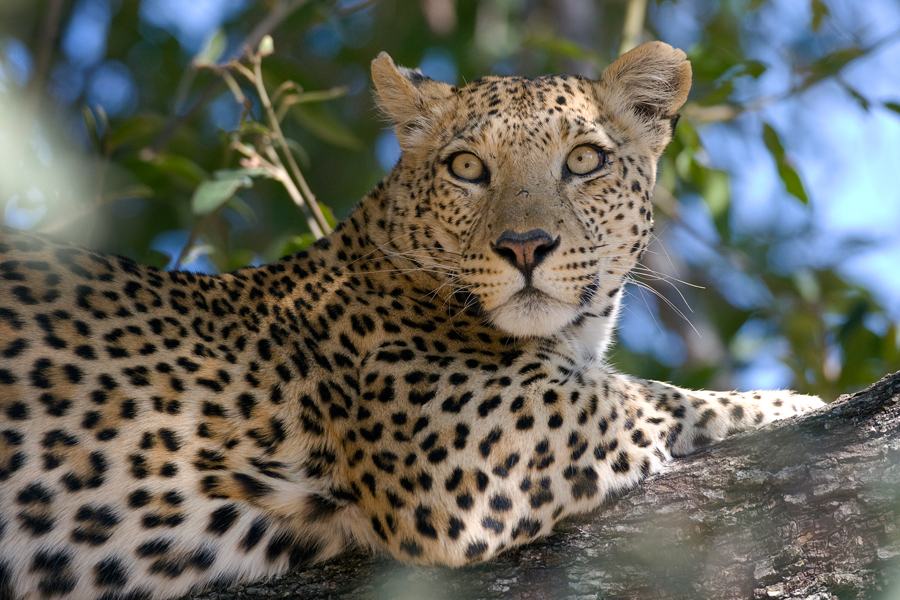
A female African Leopard up a tree

Wild female Leopard
Photograph: Patrick Meier

The story of how this particular female Leopard came to be up a tree is recounted by Patrick, the photographer:

“This photo was taken in a place called Xakanaxa, in the Moremi Game Reserve, Northern Botswana. We followed this female leopard for about 20 minutes. She went up and down some tall trees, getting closer and closer to a herd of impala. Eventually, when she started to stalk, she vanished from our sight in a single leap.”

The African Leopard (Panthera pardus pardus) is a leopard subspecies occurring across most of Sub-Saharan Africa. The International Union for Conservation of Nature (IUCN) classified leopards as Near Threatened in 2009, stating that they may soon qualify for the Vulnerable status due to habitat loss and fragmentation. They are becoming increasingly rare outside protected areas and the population is decreasing gradually. The most secretive and elusive of the large carnivores, Leopards are solitary creatures and predominately nocturnal.

Leopards are known for their ability in climbing (and said to be the strongest climber of the large cats). By climbing, the Leopard can use this vantage point to gain a better view of possible prey in an area. These cats have been observed dragging their kills up trees and hanging them there.
They are powerful runners, reaching speeds of up to 36 mph in the chase. They are also capable swimmers (although not as strong as some other big cats, such as the tiger). They are very agile, and can leap over 6 metres (20 ft) along the ground, and jump up to 3 metres (10 ft) vertically.

Leopards are versatile, opportunistic hunters, and have a very broad diet. They feed on a greater diversity of prey than other members of the Panthera species, and will eat anything from dung beetles to male giant elands, up to 900 kilos in weight. Their diet consists mostly of ungulates (hooved animals) and monkeys, but they also eat rodents, reptiles, amphibians, insects, birds, and fish. In Africa, mid-sized antelopes provide a majority of their prey, especially impala and Thomson’s gazelles.

They have been heard producing a number of vocalizations, including grunts, roars, growls, meows, and “sawing” sounds. To hear some of these recorded sounds you may want to try this link.

Sources : Personal account by Patrick Meier, Wikipedia.org and other Big Cat websites.

Castle Castro Cats

Just got back from my summer holiday and (as usual) I took a few photos of some of the scenery and wildlife we happened upon…. and not surprisingly, some moggies were amongst the collection.

Photo of Castle Castro

Castle Castro
Old Skiathos town was founded here in 1538!

Castro or Castle Castro is the medieval town of Skiathos in Greece, which was built on a gigantic rock several hundred feet above sea level. Castro is situated in the northern part of this Greek island, and took us around an hour by boat to reach from the new capital of the island.

Castle Castro Cat
taking shade in the heat of the day.

Amongst the ruins stand some middle ages houses and at least three churches (I counted). High on the clifftop are stunning panoramic views of the Aegean sea which can be seen in the photographs above. A single cannon from those ‘days of pirates’ is still intact amongst the remains of the ruined town. Amazingly Castro was the old capital of this island from 1538 until 1829.
[teaserbreak]

Castro Cat at the ouzo table.

Set out on a table outside the highest church were a couple of little bottles of ouzo and some glasses. These, together with a tray of boiled sweets, were kindly provided by the church warden.

Word got round that this was free to drink and we didn’t want to disappoint did we!… Anyway a few minutes later several local moggies appeared which looked to be quite well fed and friendly.

[teaserbreak]
..and a couple more Skiathos moggies for good measure…

Sadly not all the cats and dogs we saw on the island were as well looked after as the Castro cats. I’ve provided a link below to the local cat (and dog) sanctuary on the island. This husband and wife team (Peter and Sharon Hewing) look after the islands unwanted strays and outcast domesticated animals all year round, but the end of the holiday season is a particularly difficult time!