
Ocicat

The Ocicat is a new and still-rare breed of cat which has spots resembling a ‘wild’ cat and the temperament of a domestic animal, named for its resemblance to the ocelot. Despite its appearance, there is no ‘wild’ DNA in the Ocicat’s gene pool. The species is actually a mixture of Siamese and Abyssinian, and later American Shorthairs (silver tabbies) were added to the mix and gave the breed their silver colour, bone structure and distinct markings.

Ocicat

Ocicat – named for its resemblance to the Ocelot and still a rare breed

The first breeder of Ocicats was Virginia Daly, of Berkley, Michigan, who attempted to breed an Abyssinian-pointed Siamese in 1964. The first generation of kittens appeared Abyssinian, but the surprising result in the second generation was a spotted kitten, Tonga, nicknamed an ‘ocicat’ by the breeder’s daughter. Tonga was neutered and sold as a pet, but further breedings of his parents produced more spotted kittens, and became the base of a separate Ocicat breeding program. Other breeders joined in and used the same recipe, siamese * aby, and offspring * siamese. Today the ocicat is found all around the world, popular for its temperament but wild appearance.

Ocicats are a very outgoing breed. They are often considered to have the spirit of a dog in a cat’s body. Most can easily be trained to fetch, walk on a leash and harness, come when called, speak, sit, lie down on command and a large array of other dog-related tricks. Some even take readily to the water. Ocicats are also very friendly. They will typically march straight up to strangers and announce that they’d like to be petted. This makes them great family pets, and most can also get along well with animals of other species. Ocicats make excellent pets for people who want to spend a lot of time with their cat, but they do require more attention than cats who aren’t so people-oriented.

An Ocelot

Ocelot – South American / Mexican wild cat.

There are twelve colors approved for the ocicat breed. Tawny, chocolate and cinnamon, their dilutes, blue, lavender and fawn, and all of them with silver: black silver (ebony silver), chocolate silver, cinnamon silver, blue silver, lavender silver and fawn silver.
Norwegian Forest Cat

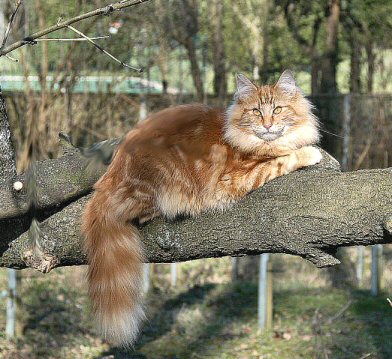
The Norwegian Forest Cat is a breed of domestic cat native to Northern Europe, and adapted to very cold climates. In Norway they are known as Skogkatter or Skaukatter (skog and skau being forms of the word for ‘forest’ in different Norwegian dialects) or more properly, the Norsk Skogkatt (literally, Norwegian Forest Cat).

Norwegian Forest Cat

Norwegian Forest Cat.

The breed is very old, and occurred as a natural adaptation to the cold climate of the region, but it was not regarded as anything other than a standard house-cat until the late 1930s, when a small number of ‘Skaukatts’ were shown in Germany and received very favourably by the judges. World War II brought an abrupt end to the fledgling Norwegian show cat industry, and the breed was forgotten until the 1970s.

The cats are now being bred and shown in several countries including the United States. The first international association to accept the breed was FIFe, in 1977. They are rumored to be the early ancestors of the Maine Coon and the long-haired Manx. Like Maine Coons, Norwegian Forest Cats are an intelligent, robust and playful breed. They like the outdoors, are well suited to cold conditions and are great hunters. Despite their great affection for the outdoors, however, they also enjoy the company of humans and other pets and will sometimes go looking for company if left alone by their owners. They are not easily stressed and are quite patient, which makes them great for a family with children. They appreciate high vantage points and enjoy climbing trees, or, if they are indoor cats, climbing on appliances, bookshelves and other elevated surfaces in the home.

Norwegian Forest Cats have a thick fluffy double-layered coat, tufted ears and a long bushy tail to protect them against the cold. Their coat is essentially waterproof due to its coarse outer layer and dense underlay. They are very large cats with adult males weighing 6 to 10 kg (13 to 22 lb), while females are approximately half that size. Their hind legs are longer than their front legs. They are very intelligent, playful cats that enjoy human company. The nickname of “Wegie” began in the United States and is a shortened version of the word Norwegian.

Norwegian Forest Cat Website