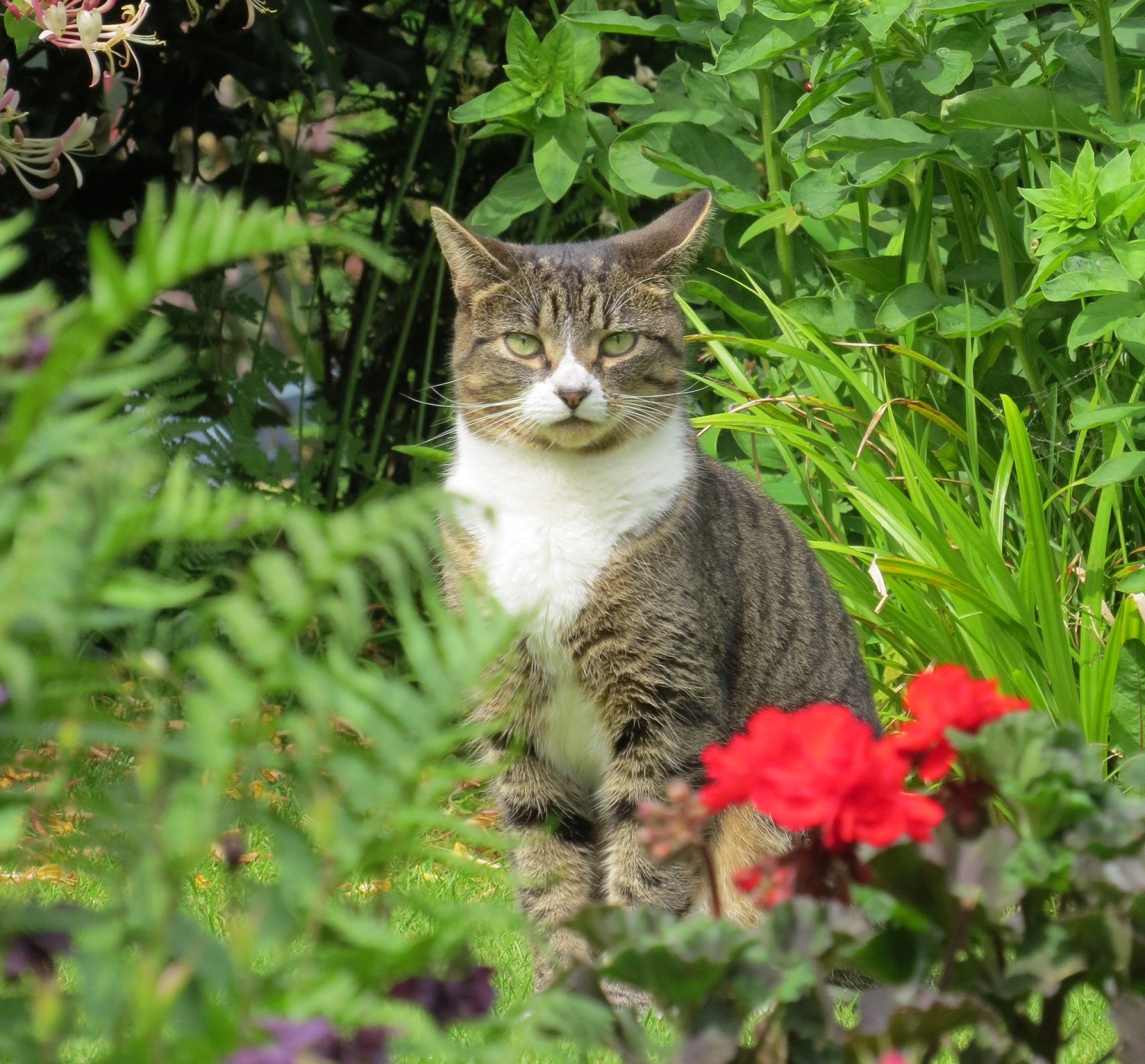
Here are some of the cat classifications I’ve found whilst looking at the different breeds and ‘house cats’. There are probably many others. Please comment with any new classification you may have heard of and I’ll add it in
“American Keuda”
An emerging breed of cat. The Keuda is under active development, however it has already become semi-standardized. If it were recognized by a major cat registry, it would probably be classified as a “Provisional” breed, but the desired characters are not entirely developed and/or stable).
“Bi-colour”
The bi-colour cat has white fur mixed with fur of other colors, an example would be black or cream. They come in different patterns. These range from color on the crown of the head and the tail only, or a solid color with a small mark of another color.
“Domestic longhaired”
The domestic longhaired cat (domestic longhair)is a term used to describe a cat with medium or long hair that is not a pedigreed member of a recognized breed. Domesticated longhairs appear in all standard cat colours including cream, tortie, smoke etc.
“Domestic shorthaired”
The domestic shorthaired cat (domestic shorthair),is a term used to describe a shorthaired cat that does not have a pedigree or belong to a recognized cat breed. The domesticated shorthair should not be counted as an American shorthair. Domesticated shorthaired cats are found in a wide range of colours. They also show a wide range of physical behaviors and, as a result, domesticated shorthairs in different countries look different in body shape and size.
“Dwarf”
This is a domesticated cat breed which has mutated to dwarfism due to a genetics.The Munchkin is the founding breed of the chondrodysplastic cat.
“Farm”
Farm cats are also called barn cats, these cats are kept primarily for catching smaller vermin found on farms and ranches. otherwise the vermin would eat and/or contaminate the farmer’s crops. They are often semi-wild, and caution should be used around them.
“Feral”
This cat is unowned and untamed, it is not domesticated. Feral cats may be born in the wild and never socialized. They should not be confused with the wildcat which are not descended from domestic cats.
“Maltese”
This is a name that is often given to any cat, whose fur is either completely, or primarily, gray or blue,and not pedigree. Many with such colouration inhabit the island of Malta, which may have given rise to the name.
“Moggy”
This is a British term for a domestic cat, it is also used to call a mongrel or mixed-breed cat. Because of this mixed ancestry and free-breeding, a moggy can either be very healthy, or, sickly.
“Odd-eyed”
This is a cat with one blue eye and one green eye or yellow or brown eye. It is a cat form of complete heterochromia. This is a condition that occurs in some other animals also. The condition most often affects white colored cats.
“Polydactyl”
A cat with a congenital physical deformity,it may have more than the usual number of toes on one or all of its paws. this is due to a genetic mutation. In animals including humans, polydactyly is the anatomical abnormality of having more than the usual number of toes or fingers.
“Smoke”
Is the name given to the cat colour in which the bottom eighth of each hair is white or creamy-white, with the rest of the hair being a solid colour. Smokes will look solid coloured until they move, then the white undercoat becomes visible. It is mostly found in pedigreed cats.
“Squitten”
This is a word derived from the words squirrel and kitten, it is a term used to describe a cat with unusually short forelegs or unusually long hindlegs that resembles a squirrel. Sometimes the term kangaroo cat is used; this derives from a 1953 specimen known as the Stalingrad Kangaroo Cat.
“Tabby”
This is a cat with a distinctive coat that features dots,stripes or swirling patterns. Tabbies are not a breed of cat, in fact, the tabby pattern is a naturally occurring feature that may be the original colouration of the domestic cat’s ancestors. Tabby colour is found in many breeds of cat, as well as among the general ‘moggy’. The tabby usually has an “M” mark on its forehead.The word comes from French ‘tabis’ and in medieval Latin ‘attabi’. The initial origin of the word seems to be from Baghdad where a type of striped silk was made that was later used to describe cats.
“Tortoiseshell”
This beauty has a coat coloring with patches of black,red and chocolate, or cinnamon. They are sometimes called ‘torties’.The term “tortoiseshell” is typically reserved for cats with coats that have relatively few or no white markings. Those that are largely white with red and black patches are described as tortoiseshell-and-white or calico.
“Black”
It is called a felid the fur is uniformly all black.It is not a particular breed of cat and may be mixed. The all-black pigmentation is equal in both male and female cats. The black color is of benefit to a cat hunting at night. They can camouflage in the darkness. In Western history, black cats have often been looked upon as a symbol of evil omens: in other cultures they are considered to be good omens. cat-categories continued.
Of all the carnivores, cats are the most highly adapted for hunting and devouring their prey. All cats have short muzzles,rounded heads, large eyes, and sensitive whiskers. Their ears are erect and pointed. They have short jaws and long canine teeth. Cats have five toes on the front feet and four on the rear feet. The ends of the toes bear sharp, strong, curved claws. The claws are completely retractile, being withdrawn into protective sheaths when not in use.