
Balinese

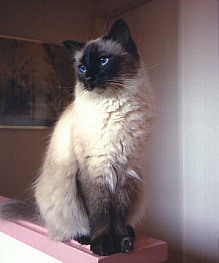
The Balinese is a breed of oriental cat with long hair and Siamese-style markings, or points. They resemble a Siamese with a medium-length silky coat and a plumed tail, but not nearly as fluffy as a Himalayan, and they require much less grooming. Balinese are extremely intelligent cats, although less talkative than their Siamese ancestors.
Balinese

Balinese – So named after the graceful Balinese dancers.

The Balinese was originally registered as a ‘longhaired Siamese’, and examples were known from the early 1920s. The occasional long-haired kittens in a Siamese litter were seen as an oddity, and sold as household pets rather than as show cats. This changed in the mid-1950s, when two breeders, Mrs. Marion Dorsey of Rai-Mar Cattery in California and Mrs. Helen Smith of MerryMews Cattery in New York, decided that they would commence a breeding program for the longhaired cats. Helen Smith named the cats ‘Balinese’ because she felt they showed the grace and beauty of Balinese dancers, and because ‘longhaired Siamese’ seemed a rather clunky name for such graceful felines. The breed became quite popular after this, and a number of breeders began working on ‘perfecting’ the Balinese appearance. This led eventually to the development of two entirely separate ‘strands’ of Balinese cat – some owners prefer a traditional or ‘apple-headed’ Balinese, while breeders and judges tend to prefer a more contemporary appearance.

Like the Siamese, there are now two different varieties of Balinese being bred and shown – ‘traditional’ Balinese and ‘contemporary’ Balinese. The traditional Balinese cat has a coat approximately two inches long over its entire body and it is a sturdy and robust cat with a semi-rounded muzzle and ears. The traditional Balinese closely resembles a Ragdoll cat although they do not share any of the same genes or breeding other than having a partially Siamese ancestry. A ‘contemporary’ Balinese has a much shorter coat and is virtually identical to a standard show Siamese except for its tail, which is a graceful silky plume.

In most associations, the Balinese is accepted in a full range of colors, including the four traditional Siamese point colors of seal, blue, chocolate, and lilac, as well as less traditional colors such as red and cream, and patterns such as lynx (tabby) point and tortie point. However, in CFA, the Balinese is only accepted in the four traditional Siamese colors; all other colors and patterns are considered Javanese (cat).
Korat, Good Luck Cat

The Korat is one of the oldest stable breeds of cat. Originating in Thailand, it is named after the Nakhon Ratchasima province, although in Thailand it is often known as Si-Sawat, which means good fortune. In fact they are often known colloquially as the “Good Luck Cat” and are given in pairs to newlyweds or people of high esteem as a wish for good luck.

Korats are a rare feline, even in their native Thailand, and remain the most highly prized cat of the Thai people; who think of the Korat as their national cat, (not the Siamese, as you might think).

The first known written mention of the Korat was in “The Cat-Book Poems” authored between 1350 and 1767 AD in Thailand, now preserved in the National library in Bangkok. They first appeared in America in the 1950s and arrived in Britain from there in 1972.

Korat

Korat – “known to form strong bonds with humans”

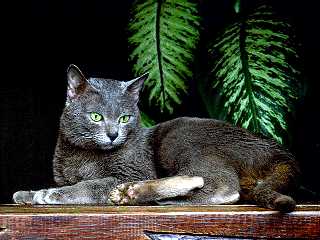
Korat cats are a shorthair breed with a small to medium build and a low percentage of body fat. The Korat is a slow maturing, medium sized cat with a smooth curved body and a heart-shaped face. The eyes are large and are luminous green in colour. The body is semi-cobby muscular and firm, with a blue coat well tipped with silver. The Korat can be a very vocal cat, but this does not usually indicate aggression. They are surprisingly heavy for their size and are highly active. They can form strong bonds with people.

Korats have many characteristics that together distinguish them as a breed. Here are just a few of Korat characteristics which are sought at Cat Shows.

  • Head – The Korat should have a heart-shaped head and face when viewed from the front. The forehead should be large and flat.
  • Nose – The nose has a downward curve just above the nose leather and the required stop should be easily seen in profile.
  • Chin – Chin and jaw should be strong and well developed, completing the heart-shaped head.
  • Eyes – The eyes size and prominence is a particular feature of the breed. The eyes should be bright and almost over large, with a green luminosity as though lit from within.
  • Body – This is a cat that is lightweight in appearance, but unexpectedly heavy when picked up. The body should be supple and well muscled with the feeling of hidden power.
  • Coat – The coat should be short to medium in length, glossy and close-lying is the ideal.
  • Colour – The coat colour should be very well tipped with silver. It is the tipping that is of primary importance. The coat should be free from patchiness or tabby markings. The lightness or darkness of the colour can vary. It is the graduation from root to tip that produces the required silvery sheen.

As a final Note, Jean Johnson first introduced Korats to the US in 1959. She had lived in Thailand, where she first encountered the breed. Her first pair were named Nara (male) and Dara (female).

Breed Website:https://www.korats.org.uk