Cat of the month ~ August 2007
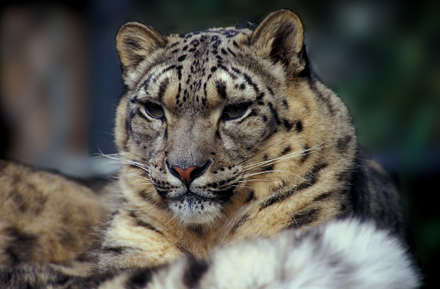
Snow Leopard at rest
The Snow Leopard Trust.
Founded in 1981, the Snow Leopard Trust is the largest and oldest organization working solely to protect the endangered snow leopard and its Central Asian habitat.
Conservation Philosophy
How do you save a snow leopard? Or a tiger, rhino, rare butterfly, or for that matter a patch of rainforest? These are the questions that every conservation organization faces, and that challenges all of us. Conservation actions can take many forms; setting aside lands, answering critical research questions, working to change government policies, partnering with communities, enforcing anti-poaching laws, or some mix of these and other efforts.
The Snow Leopard Trust use a combination of approaches that focus on partnering with communities in snow leopard habitat. They build community partnerships in addition to using science and research to determine key snow leopard habitat, assess wildlife-human conflict levels, and identify potential resources for conservation programs.
High priority areas are then chosen including key snow leopard habitat, with a history of conflict between predators and the communities, and potential resources to sustain a community-based conservation program.
When the science and research identifies an area as a priority site time is spent with local residents, listening to their hopes and concerns, and only then is a conservation program jointly developed.
Conservation efforts must meet four important goals.
1. The protection of snow leopards and their habitat, involving local communities in this effort.
2. An improved quality of life for the members of the community.
3. The program developed must have a path to becoming self-sufficient � where after a time it is no longer dependent on donor dollars.
4. The results of the program must be verifiable through monitoring programs.
The Snow Leopard Trust strives to follow these principles in all its community-based conservation efforts.
Visit the website via the link above and read about the different projects that are being implemented.
The Snow Leopard Trust constantly endeavor to improve our conservation projects to better meet the needs of cats and humans, and they are seeing wonderful results at their project sites. Here the livelihoods of families and communities have been improved greatly whilst snow leopards are being protected and their populations growing.
[Extract and Photograph from the Snow Leopard Trust Website]


