
American Wirehair

The American Wirehair breed is uniquely American. It began as a spontaneous mutation in a litter of upstate New York farm cats in 1966. A spontaneous mutation is an uncommon, although not rare, happening. As it has occurred among cats in the past, two ordinary cats came together and as a result of their mating, a kitten unlike its parents or littermates was born. The progeny of the original mutation, Council Rock Farm Adams of Hi-Fi, are now in all areas of the United States. What is interesting and unusual about this particular mutation is that it has not been reported in any other country thus far.

American Wirehair, The result of a spontaneous mutation
Photograph: unknown

The coat is the characteristic that separates the American Wirehair from all other breeds. Just as there is a wide variety of texture in Persians or Exotics, there is also considerable variation among the Wirehairs. As this is a dominant mutation, approximately half of the kittens will be wirehaired at birth. The most readily apparent wiring is that of the whiskers and ideally, the entire coat will be wired at birth. If the coat appears to be ringlets, it may be too long and may wave or straighten with maturity. Some of the lightly wired coats may continue to crimp during the early life of the Wirehair. The degree of coarseness depends upon the coat texture of the sire and dam. To produce the best wiring, both parents must have a hard coat.

Breeders find them easy to care for, resistant to disease, and good producers. Pet owners delight with their quiet, reserved and loving ways.

Weight: 8-11 lbs.

Eyes: The American Wirehair eyes are large and round. Aperture has a slight upward tilt. The color depends on the color of the coat.

Coat: Springy, tight, medium in length; overall appearance of wiring and coarseness and resilience of the coat is more important than the crimping of each hair; very dense, resilient, crimped, and coarse coat is most desirable; whiskers should be curly.

Associations: The American Wirehair is accepted by CFA and TICA.

American Curl

The American Curl is a breed of cat characterized by its unusual ears, which curl back from the face toward the center of the back of the skull.

The breed originated in Lakewood, California as the result of a spontaneous mutation. In June, 1981, two stray kittens were found and taken in by the Ruga family.
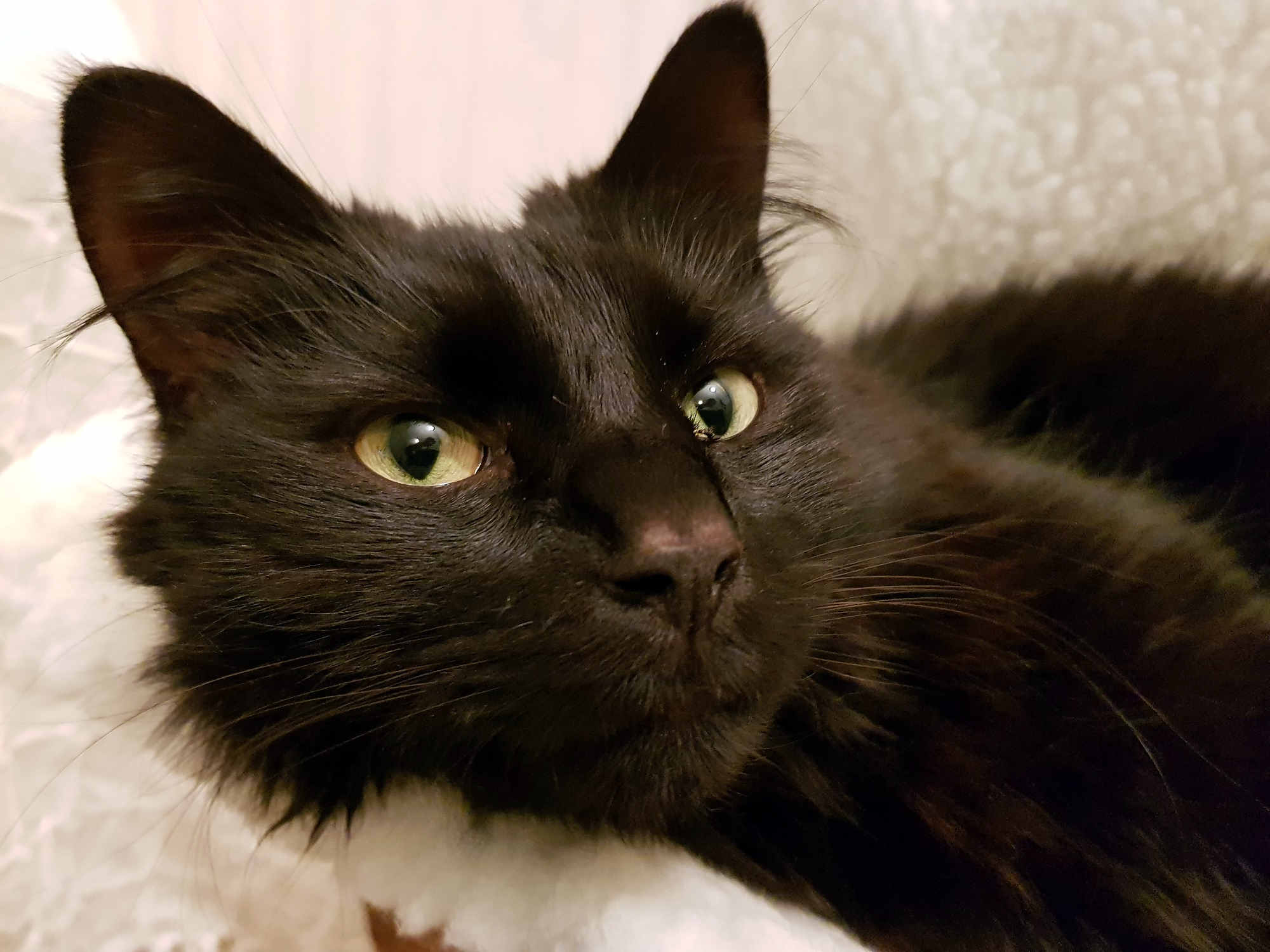
The kittens were both longhaired, one black and the other black and white. The family named them Shulamith and Panda respectively, but Panda got lost several
weeks later, making Shulamith the foundation female of the American Curl breed.

The American Curl, with characteristic curled back ears.

In 1983, an American Curl was exhibited at a cat show for the first time, and in 1987, the longhaired American Curl was given championship status by The International Cat Association (TICA). In 1993, the American Curl became the first breed admitted to the Cat Fanciers’ Association (CFA) Championship Class with both longhair and shorthair divisions.

The American Curl is a medium sized cat (5-10 lbs), and does not reach maturity until 2-3 years of age. They are strong and healthy, remarkably free of the genetic defects that affect many purebred cats.

American Curl kittens are born with straight ears, which begin to curl within ten days. After four months, their ears will not curl any longer, and should be hard and stiff to the touch. A pet quality American Curl may have almost straight ears, but showcats must have ears that curl in an arc between 90 and 180 degrees. A greater angle is preferable, but cats will be disqualified if their ears touch the back of their skulls.

Both longhaired and shorthaired American Curls have soft, silky coats which lie flat against their bodies. They require little grooming, but enjoy spending time with their owners.

The American Curl, while still an uncommon breed, is found across the world in the United States, Spain, France, Japan, Russia, and many other countries.

[Thanks to wikipedia.org]