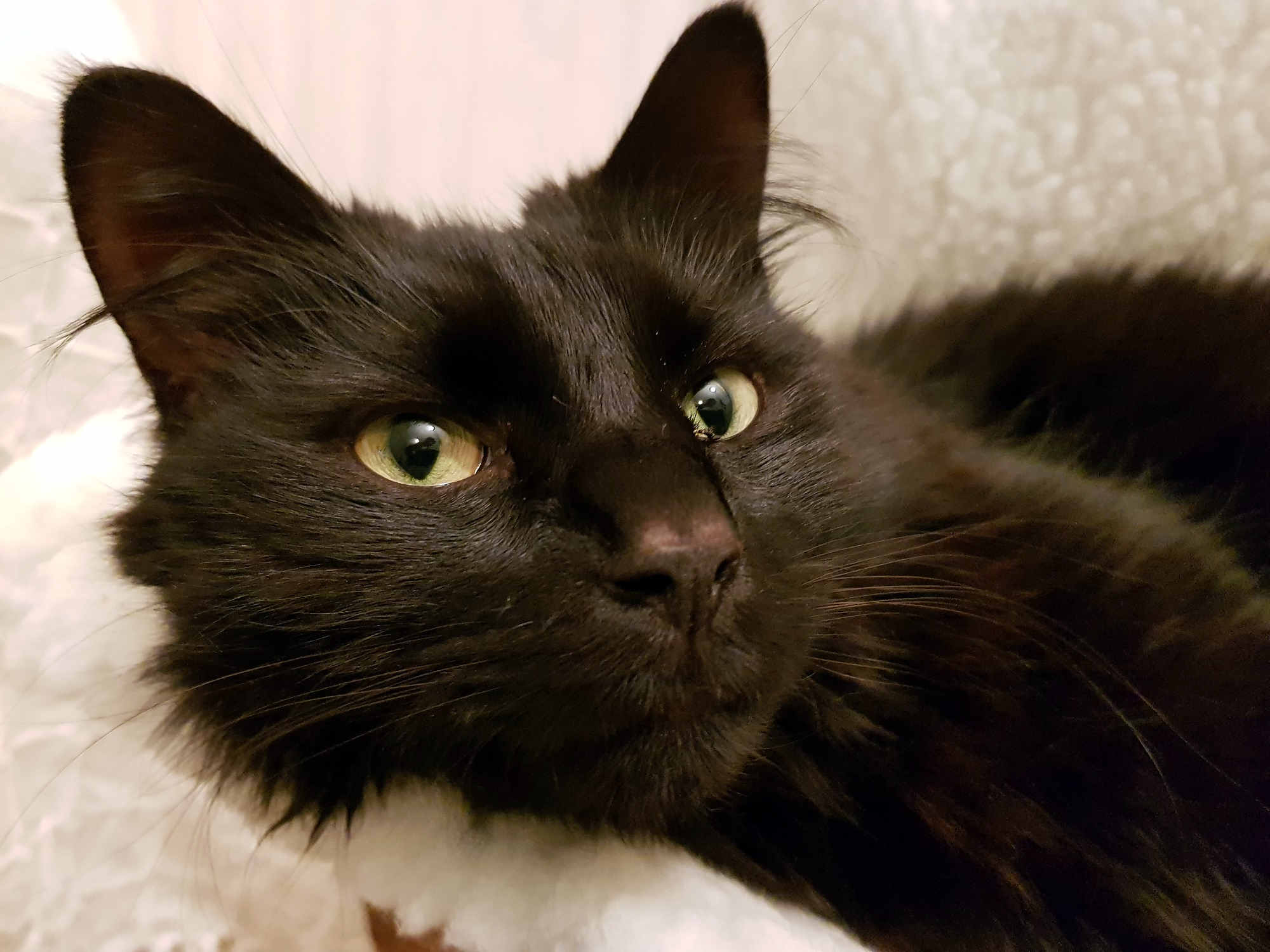
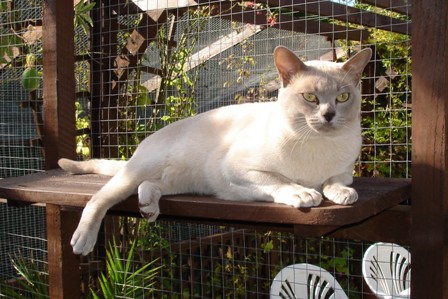
The Traditional Balinese (Applehead Balinese) cat combines the unique personality and intelligence, burly body type, pointed coloring, and the minimal shedding of the Traditional Siamese, with a softer voice and a silky coat.
They are extremely intelligent, curious and loving. Their behavior and loyalty often resembles what most people expect of a dog more than a cat, as they follow their owners about, sleeping outside of the door of any room you occupy, that they cannot enter, and amusing themselves with a toy until they can once again be on your lap.

Balinese, extremely intelligent, curious and loving cat… and there are many varieties to choose.
Agile, swift, muscular and extremely intelligent, they love to play fetch or to make up other games. They get along easily with other cats and with dogs and yet are independent enough to adjust to periods of being alone.
While they still ‘talk’ like their Siamese cousins, their voices are far softer and they speak only when they have something they feel is important to say. As such, they grow up to make delightful ‘watch-cats’ often alerting their family when strangers approach or when something seems ‘wrong’. They are very alert to their owners and surroundings, but not a hyperactive cat. Rather, they maintain an easy balance of playing and napping depending on the circumstances.
History
The early history of the Traditional Balinese is the same as the history of the Traditional Siamese. The Siamese is considered by many to be a ‘natural’ breed – that is to say, one that developed without the intervention of man.
The first Siamese cats appeared in the West in the mid-to-late 1800s. Photographs from the late 1880s of some of the first cats to be imported from Siam show the thick, round heads and solid, muscular bodies that distinguish the Traditional Siamese from today’s modern Siamese that dominate the modern show-ring.
Many say that Balinese kittens have always appeared now and again in purebred Siamese litters. Some attribute a pure Siamese appearing with a longer coat to be a simple mutation and say there are examples of early drawings that depict pointed cats with what seems longer fur. Another opinion is that it was an outgrowth of the domestication of the Palas cat (Felis Manul) who originated in western China and has a very dense coat which comes in a wide variety of colors. Others say that the longer coat is a result of the early British breeders crossing them with the then popular Angora or Turkish Angora, a cat with a tremendous history as a companion cat. The Turkish Angora was first introduced to Europe in the 14th century when the crusaders brought Turkish Angoras back home in their saddle bags .
The truth may be a bit of both. The long-haired trait persisted however, and a long-hair Siamese was registered with C.F.F. in 1928. They were not bred in earnest however until 1955 when a woman named Marion Dorsey of California began breeding and showing the longer-haired variety.
It turned out the Balinese bred ‘true’ meaning that when a Balinese was bred to another Balinese the resulting litter were all always Balinese, thus qualifying it to be a ‘pure breed’. At this time they were still referred to as Long-Haired Siamese but soon were christened ‘Balinese’ not, as many think, because it came from Bali, but because the fanciers of the time thought so graceful and athletic a cat resembled the graceful Balinese dancers.
In 1961 the Balinese was recognized and accepted for registration in the same colors as Siamese seal point, chocolate point, blue point and lilac point. Other colors such as red tabby, blue tortie, red cream, cinnamon, fawn, smoke, silver and all others were registered as Javanese, just as other colors of Siamese which emerged due to out-crossing, were registered as Oriental Shorthairs.
In the 1950s virtually all the Siamese and Balinese cats were what we think of today as the Traditional Siamese and Balinese, a heavier boned, rounder headed cat . But just as the ever changing whims of the show ring judges have dictated what body type is fashionable at any given time, the Traditional Balinese, like the Traditional Siamese, fell out of favor in the late fifties and early sixties and were gradually replaced with the modern version of the breed. The modern version is a smaller longer and thinner more angular cat with large ears and, in the case of the Balinese, a short coat on its body with the only long hair occurring on its plumy tail. This look became popular with the show-oriented Balinese breeders, while other breeders, who preferred the Traditional look, continued to breed the larger, rounder-headed Traditional Balinese. These Traditional breeders found that their cats were no longer competitive in the show ring and stopped showing though they continued breeding with their existing purebred Balinese stock.
Currently, the Traditional Balinese is quite rare, though they are beginning to make a comeback as many pet buyers and breeders alike rediscover the Traditional Balinese many endearing qualities as top-notch companion cats.
It should also be pointed out, that Traditional Balinese are purebred cats, descended from the original cats imported from Siam. A pointed cat that you find in a shelter, though it may look Balinese, is probably not a Traditional Balinese. Enough purebred Siamese, Himalayan or other pointed and long-haired cats have interbred with domestic cats over the years that the gene which creates the pointing pattern and longer hair, is found in a large number of cats. So while some may look Balinese, they may have very little Balinese blood in them.
A Balinese Cat Website