The Turkish Angora (Turkish: Ankara Kedisi) breed are one of the ancient, naturally occurring cat breeds, having originated in central Turkey, in the Ankara region.
These cats often have a white, silky, medium-long length coat, no undercoat and fine bone structure. There seems to be a connection between Ankara Cats and Persians (see below), and the Turkish Angora is also a distant cousin of the Turkish Van. Although they are known for their shimmery white coat, currently there are more than twenty varieties including black, blue, reddish fur. They come in tabby and tabby-white, along with smoke varieties, and are in every color other than pointed, lavender, and cinnamon (all of which would indicate breeding to an outcross).
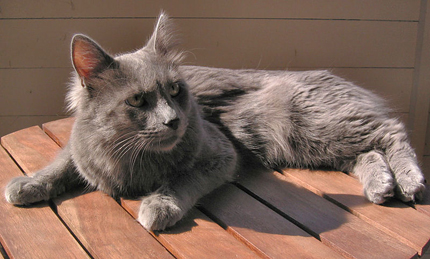
The Turkish Angora – A blue eye can often indicate that the cat is deaf!
Eyes may be blue, green or amber, or even one blue and one amber. The W gene responsible for white coat and blue eye is closely related to the hearing ability, and presence of a blue eye can indicate the cat is deaf to the side the blue eye is located. However, a great many blue and odd-eyed white cats have normal hearing, and even deaf cats lead a very normal life if indoors.
[teaserbreak]
Ears are pointed and large, eyes are almond shaped and the head is massive with a two plane profile. Another characteristic is the tail, which is often kept parallel to the back.
Turkish Angora is an intelligent, adorable and a very curious breed which is very active throughout their life-span. Some Turkish Angoras will bathe with their owners (another link to the cousin Turkish Van cat, which is known as “the swimming cat”). They also tend to bond with their owners and try to be the center of attention, often doing their part in conversations. They usually don’t like to be held for long, but like to stay in human presence, happily playing for hours.
Like all domestic cats, Turkish Angoras descended from the African wildcat. The mountainous regions of Eastern Anatolia isolated cats brought by traders from Egypt, and through inbreeding and natural selection they developed into longhaired breeds like the Turkish Van and the Turkish Angora.
Longhaired cats were imported to Britain and France from Asia Minor, Persia and Russia as early as the late 1500s, though there are indications that they appeared in Europe as early as 1300s due to the Crusades. The Turkish Angora was used, almost to the point of extinction, to improve the coat on the Persian (cat). The Turkish Angora was recognized as a distinct breed in Europe by the early 1600s.
In 1917, The Government of Turkey in conjunction with the Ankara Zoo began a meticulous breeding program to protect and preserve what they considered a national treasure, pure white Turkish Angoras with blue and amber eyes. The program continues today. The zoo particularly prized odd-eyed Angoras (ie. Turkish Angoras with one blue eye and one amber eye). The Zoo has its own cat facility which houses the white Turkish Angoras for its breeding program.
Turkish Angora, which was most recently brought to the United States in 1963, was accepted as a championship pedigreed breed in 1973 by the Cat Fanciers’ Association. However, until 1978 only white Angoras were recognized. Today, all North American registries accept the Turkish Angora in many colors and patterns. While numbers are still relatively small, the gene pool and base of fanciers are growing.
In the Turkish Angora, an autosomal recessive hereditary ataxia is found. The kittens affected by this ataxia do not learn to move and die young. The genetic cause of this ataxia is not yet known. Another genetic illness known to the breed is HCM], which is an autostomal dominant gene wich affect many other breeds (from Maine Coons to Persians).
Many Thanks to Wikipedia. https://en.wikipedia.org/wiki/Main_Page