
“Moggy” – origin of the word

Moggy or moggie (plural moggies) is a British affectionate term for a domestic cat, but is also used as alternative name for a mongrel or mixed-breed cat whose ancestry and pedigree are unknown or only partially known. Because of this mixed ancestry and free-breeding, a moggy can either be very healthy, or, if from an inbred feral colony, genetically unsound and sickly. However, as feral colonies are often left without any form of human intervention and veterinary attention, the sickly generally do not live past kittenhood, leaving the colony as a whole healthy.

Etymology
The origin of the word moggy is not a corruption of the word ‘mongrel’, as many believe. It was first recorded in 1911, and was possibly derived from maggie, margie or mog, all short forms of the female name Margaret. It is thought this was first used to describe an ungainly lumbering old cow, and it may even have been a minor rural English name for any cow; since ‘moggy’ was used in several 1800s English dialects as an ‘affectionate name’ for a cow. As rural people flocked to the cities during the latter part of the Industrial Revolution, it seems likely that the cow moggy became maggie, applied as a term of abuse for a dishevelled old woman or ‘woman of the street’.

The origin is obviously confused, but as the early 20th century streets of London became filled with very many unhealthy looking stray cats, it would have been natural to apply the term moggy to describe these unfortunate creatures.

In parts of Lancashire, England the word ‘moggy’ means mouse not cat. A cat was known as ‘the moggy catcher’. It has been suggested that this could be the etymology of the word moggy meaning ‘cat’ – over time the catcher part was dropped from ‘the moggy catcher’ and so moggy now means both ‘mouse’ and ‘cat’.

Thanks Wikipedia, the free encyclopedia
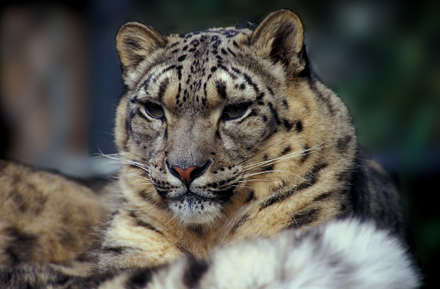
Snow Leopard

Cat of the month ~ August 2007

snowleopard

Snow Leopard at rest

The Snow Leopard Trust.

Founded in 1981, the Snow Leopard Trust is the largest and oldest organization working solely to protect the endangered snow leopard and its Central Asian habitat.

Conservation Philosophy

How do you save a snow leopard? Or a tiger, rhino, rare butterfly, or for that matter a patch of rainforest? These are the questions that every conservation organization faces, and that challenges all of us. Conservation actions can take many forms; setting aside lands, answering critical research questions, working to change government policies, partnering with communities, enforcing anti-poaching laws, or some mix of these and other efforts.

The Snow Leopard Trust use a combination of approaches that focus on partnering with communities in snow leopard habitat. They build community partnerships in addition to using science and research to determine key snow leopard habitat, assess wildlife-human conflict levels, and identify potential resources for conservation programs.
High priority areas are then chosen including key snow leopard habitat, with a history of conflict between predators and the communities, and potential resources to sustain a community-based conservation program.

When the science and research identifies an area as a priority site time is spent with local residents, listening to their hopes and concerns, and only then is a conservation program jointly developed.

Conservation efforts must meet four important goals.

1. The protection of snow leopards and their habitat, involving local communities in this effort.
2. An improved quality of life for the members of the community.
3. The program developed must have a path to becoming self-sufficient � where after a time it is no longer dependent on donor dollars.
4. The results of the program must be verifiable through monitoring programs.

The Snow Leopard Trust strives to follow these principles in all its community-based conservation efforts.
Visit the website via the link above and read about the different projects that are being implemented.

The Snow Leopard Trust constantly endeavor to improve our conservation projects to better meet the needs of cats and humans, and they are seeing wonderful results at their project sites. Here the livelihoods of families and communities have been improved greatly whilst snow leopards are being protected and their populations growing.

[Extract and Photograph from the Snow Leopard Trust Website]